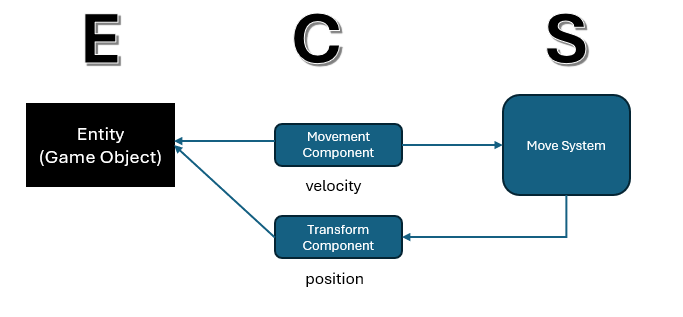
What is an ECS
Why ECS Matters
Game design often relies on inheritance: you make a Player class, an Enemy class, maybe a FlyingEnemy subclass, and so on. This can get messy quickly:
- Hard to reuse logic
- Difficult to add new behaviors
- Easy to introduce bugs when changing one class
ECS flips the model:
- Entities are dumb containers
- Components are small, focused data
- Systems do the heavy lifting
A Quick Peek at ECS in Action
tsconst player = new ex.Actor({ x: 100, y: 100 });//Attach the component to the playerplayer.addComponent(new HealthComponent());//Attach the system to the engineengine.world.add(new HealthSystem());player.get(HealthComponent).damage(20);
Even this small snippet shows the ECS philosophy:
- The player has a health component
- A system observes and reacts to the health
- Logic is centralized and predictable, not scattered across your game objects
Let's break this down so we map ECS fundamentals to Excalibur's implementation.
Entities
Excalibur has an entity class, its simply a container of components.
Actors are 'premade' entities that come with several commonly used components on them already
- Colliders Component
- Transform Component
- Body Component
- Motion Component
- Pointer Component
- Actions Component
- Graphics Component
These allow Actors to have, out of the box, these behaviors: movement, shape/size, hit things, have sprites shown, and respond to mouse clicks.
We will discuss how to make your own custom Components in this series.
Components
Components are simply a collection of data tied to a behavior.
For example: for the Motion Component you have:
- velocity (vel)
- acceleration (acc)
- maxVel
- torque
- inerta
These are all 'values' and data that are bolted on to an entity that allows the Motion System to use that data to 'move' the entity over time.
Systems
Systems are where the business logic resides. The process and workflow of a system is as follows.
-
On each update, the system collects ALL entities with the respective components on it needed
- These are called Queries, the 'search' for all impacted entities
-
For each entity that is affected by the System, it uses the systems logic to modify any or all of the data associated with that entity
This is best explained in an example.
tsimport { Actor, Engine, Component, System, SystemType } from 'excalibur';// 1. Component: Healthclass HealthComponent extends Component {current = 100; // <---------- THIS IS THE DATA (COMPONENT)constructor(){super();}damage(amount: number) { //<---- you can do this too ;)this.current = Math.max(0, this.current - amount);}}// 2. System: Check health and kill actor if zero <----THIS IS THE BEHAVIOR (SYSTEM)class HealthSystem extends System {systemType = SystemType.Update;query: Query<typeof HealthComponent>;constructor(world: World) {super();this.query = world.query([HealthComponent]);}update(delta: number) {for (const entity of this.query.entities) { //<--- LOOP THROUGH ALL ENTITIES FOR THIS SYSTEMconst health = entity.get(HealthComponent);if (health.current <= 0) {entity.kill();console.log(`${entity.name} has died!`);}}}}// 3. ENTITY SETUPconst player = new Actor({ x: 100, y: 100, width: 32, height: 32 }); // < ----- THIS IS THE ENITYplayer.addComponent(new HealthComponent());// 4. Damage the playerplayer.get(HealthComponent).damage(50); // player still aliveplayer.get(HealthComponent).damage(60); // triggers system → player dies
What makes ECS so useful is that if you have a certian mechanic that can be re-used for different Actors or Entities, then slap a component on it and the system will just 'pickup' that behavior for that actor, makes it super easy to extend behaviors without re-writing code.
In this example, you can give any Actor the ability to have health and die simply by adding the component to it.